Technology
Creating Appointment Time Slots in Achieve
Last modified 8/26/2026
Once you have an Achieve account and profile, you must create appointment time slots so individuals can sign up for appointments with you.
Before You Begin
Achieve is a web-based application that allows you to sync appointments with your Outlook calendar.
Access to Achieve is required before you can schedule appointments. The term “appointment time slots” refers to a span of time during which you schedule appointments. You also need to create a profile in Achieve. For more information, see Achieve.
Creating Time Slots in Achieve
- Log in to Achieve with your ULID (the first part of your email address before @ilstu.edu) and your ISU password.
- Expand the Staff menu on the left side of the screen using the plus ( + ) sign.
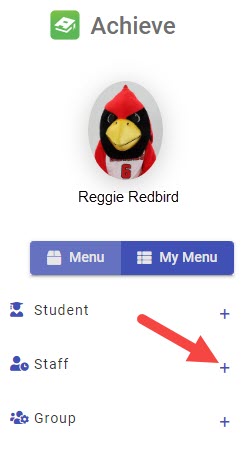
- In the expanded Staff menu, select Create Time Slots. This will open the Create Time Slots page.
- Click the Create New Time Slots button.
- Use the dropdown menus to select the appropriate Department and Program for your time slots.
- Use the dropdown menu to select your name as the Staff (advisor/tutor/counselor/faculty).
- Enter a title for your appointment time block in the Subject line. This will appear when individuals sign up for an appointment.
- Enter the Location for your appointments.
- Select a Start Time and an End Time for your time slots. You can set multiple appointments within a multiple hour time slot.
- Select a Start Date and an End Date. If you are scheduling office hours for a course, you can schedule time slots for an entire semester.
Note
Time slots appear within a 90 day window. Therefore, if you create a time slot outside of the 90 day window, you will not see this time slot as an option on your page. However, this time slot will appear once it is within the 90 day window.
- Select the Appointment Block Type. Choose between a Single Appointment Block or Multiple Appointment Block.
- If you choose Multiple Appointment Block, you will indicate how long you want each appointment time slot to be. The shortest appointment time is fifteen minutes.
- Select the Appointment Type.
- This indicates how many individuals will attend one appointment. Walk-In appointments are only used for departments that have walk-in kiosks. Walk-In appointments will not be displayed on your profile.
- Indicate your Schedule. If you want the time slots to occur on specific days of the week, click the check box next to those days.
- If needed, enter a note in the Note to show with the appointment. Each individual who signs up for an appointment will see this message in the confirmation email.
- Click Save.
A list of your current time slots will be listed.
Appointment Type
There are three types of appointment types in Achieve:
- Face-to-face/in-person
- Virtual
- Phone
Note
Appointment types first need to be set up in your Staff Profile. If you have not yet set these up in your profile, please follow the steps in Create a Profile in Achieve under the "Appointment Type" section before proceeding.
For each appointment type, enter information in each applicable field that students need to know in order to attend the meeting. For example, enter the location of a face-to-face meeting in the "Face-to-face/in-person appointment office location" field.
When a client signs up for an appointment, the information in the field will be displayed next to the time slot.

Face-to-face/in-person
In the "Face-to-face/in-person appointment office location" field, enter the location of the meeting (office number, room name, etc.).
Virtual appointment (Zoom/Team/WebEx) location URL
In the "Virtual appointment (Zoom/Team/WebEx) location URL" field, enter the URL the student will need to select in order to attend the virtual meeting.
Phone appointment location
In the "Phone appointment location" field, enter the phone number the client will call to have a phone appointment with you.
Once the field (or fields) have been updated, select the Save button at the bottom of the screen to save your changes. Next, start creating time slots and use these fields to indicate in your created time slots the type of appointment students are signing up for and how they will attend their appointment with you.
Time Slots
Set your time slots to reflect the types of appointments that you can offer clients.
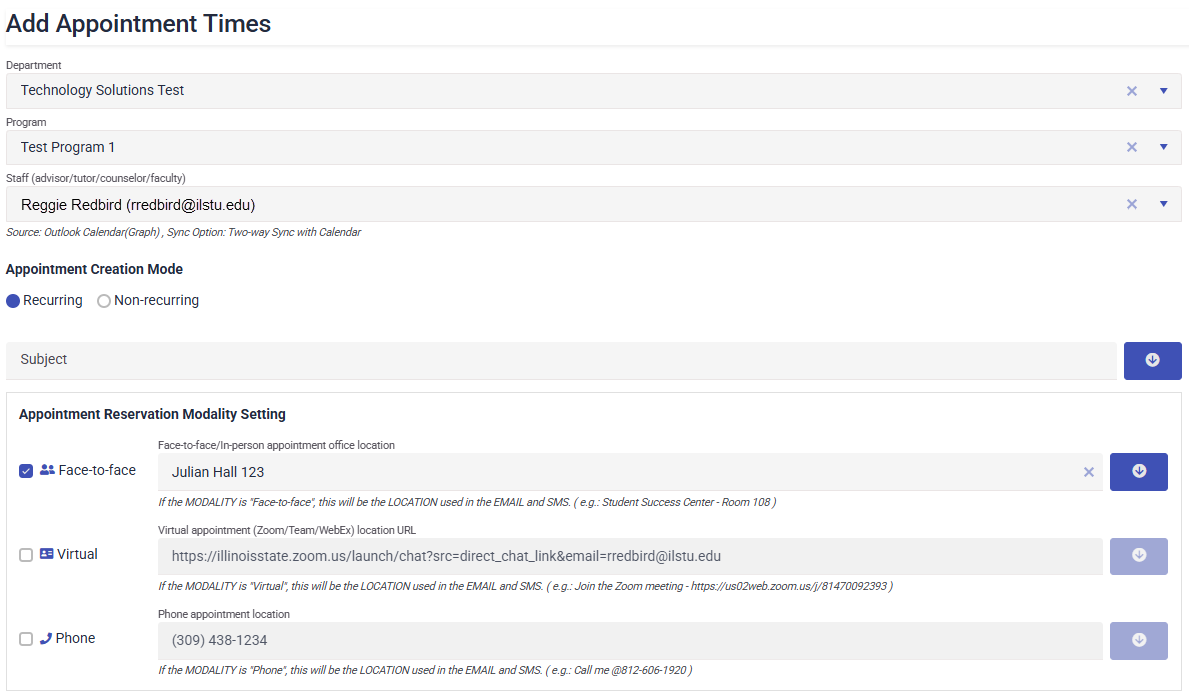
After setting your location fields in your profile, select the appointment type when making time slots using the checkboxes next to "Face-to-face", "Virtual", and "Phone" in the "Appointment Reservation Modality Setting" section.
This information is displayed when students select a time slot on your public facing Achieve page. For example, if a person selects a virtual meeting, your virtual appointment link will be displayed.
Public-Facing Achieve Page
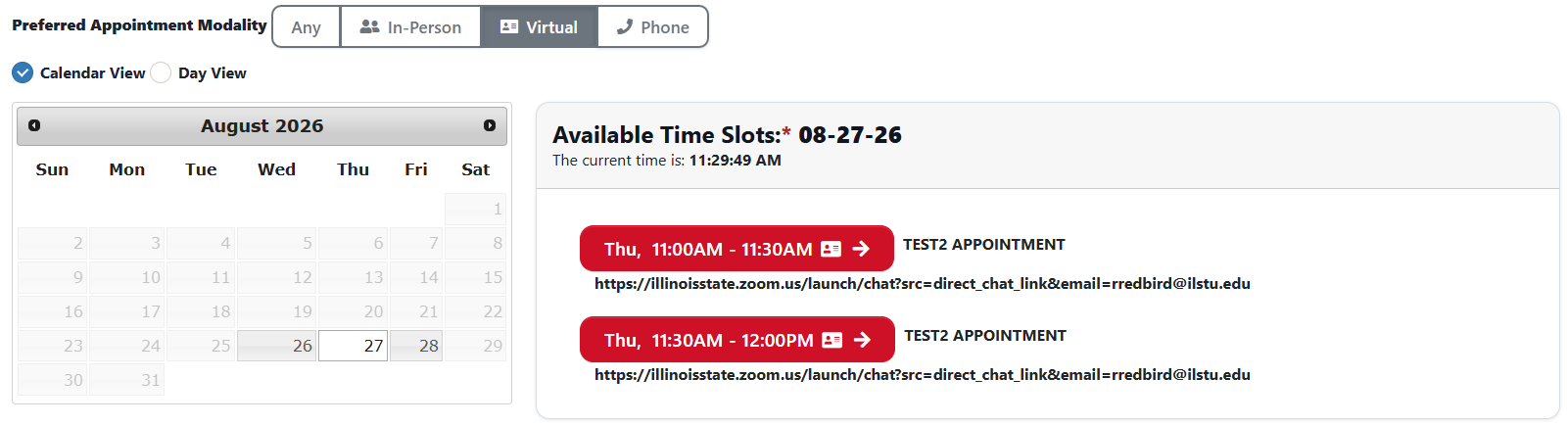
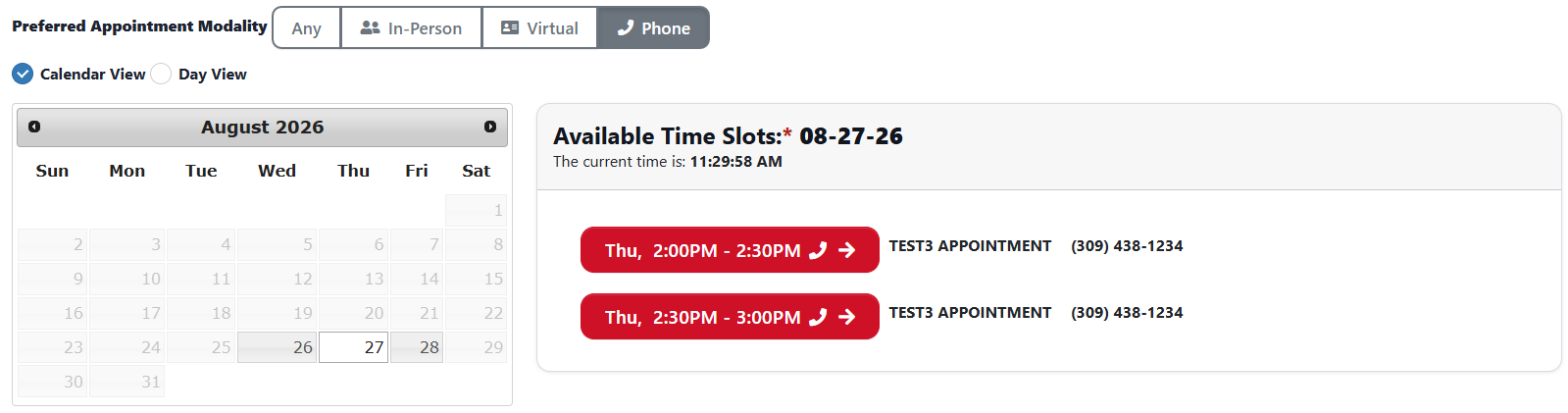
Once your time slots have been completed, this is what students will see on your public-facing Achieve page:
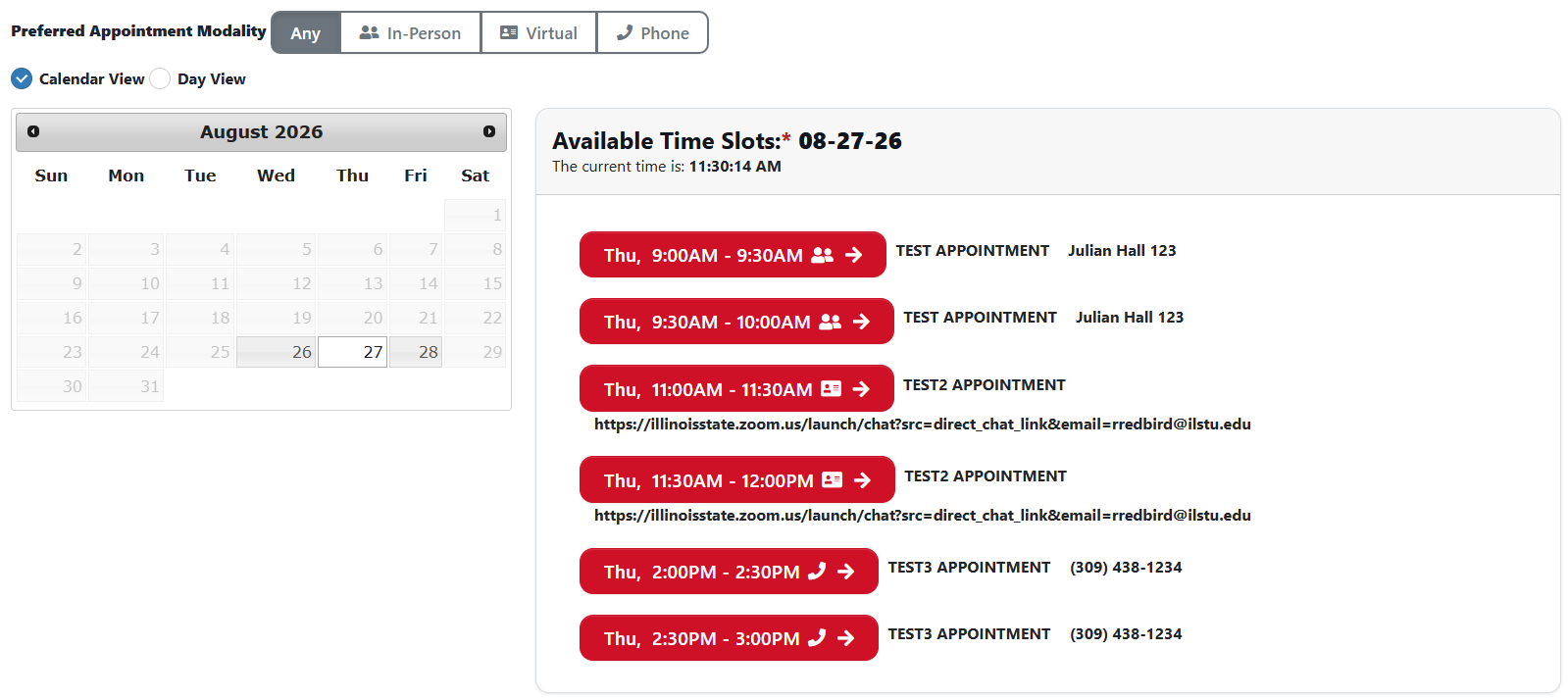
Student will use the buttons above the calendar to choose the type of appointment they would like: Any, In-Person, Virtual, or Phone.
Note how next to the appointment time slot, specific location information is displayed, such as the virtual meeting URL and phone number.
Any
Choose Any to display any type of appointment during the selected day.
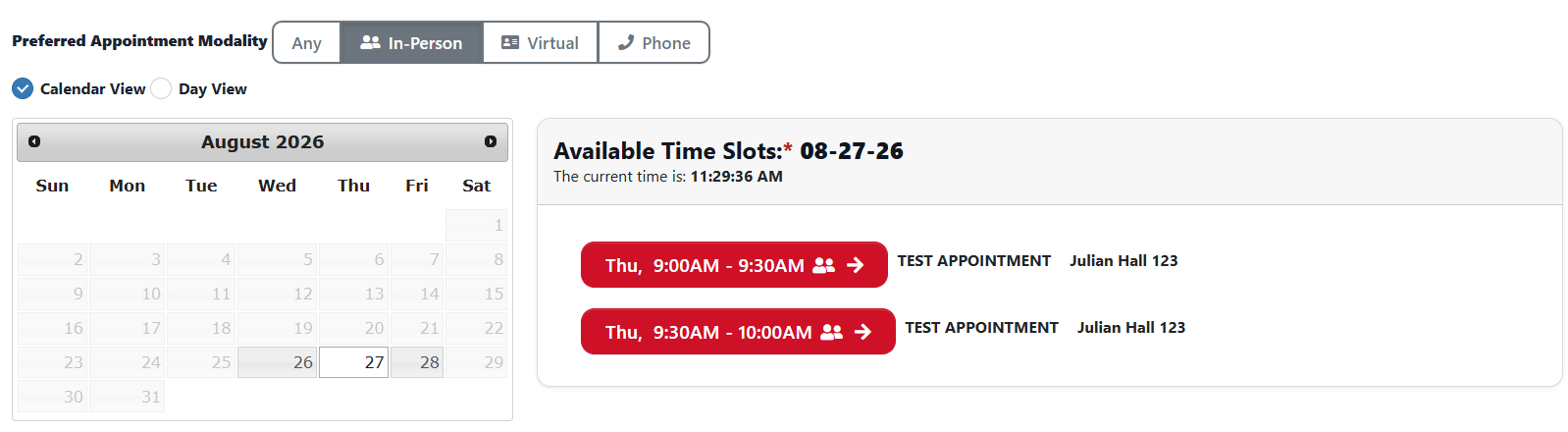
In-Person
Choose In-Person to only display appointments during which you meet face-to-face during the selected day.
Virtual
Choose Virtual to only display virtual appointments during which you meet using a webcam during the selected day.
Phone
Choose Phone to only display appointments during which you chat over the phone during the selected day.
How to Get Help
Technical assistance is available through the Illinois State University Technology Support Center at:
- Phone: (309) 438-4357
- Email: SupportCenter@IllinoisState.edu
- Submit a Request via Web Form: Get IT Help Form
- Live Chat: IT Help Live Chat
Feedback
To suggest an update to this article, ISU students, faculty, and staff should submit an Update Knowledge/Help Article request and all others should use the Get IT Help form.